Tuesday, March 28, 2017

It's late March and after a week's break, we're only through the third of six PM classes. Still lots to learn. Each class both adds to my knowledge and helps me visualize how to apply PM practices to different past and present business situations. Today I'll continue to work through the Project Integration Management section of the Project Management Body of Knowledge, the PMBOK® Guide. But let me take a lesson from the Guide and from class, and well, from the practical art of working, and reveal that only certain aspects of this next section are applicable to the Closter 5k Project. Some parts of the PMBOK® Guide are not applicable and they aren't included below even though the section of the group remains as a placeholder. This just keeps the process in perspective for me.  

4.4 Monitor and Control Project Work

4.4.1 Monitor and Control Project Work: Inputs
4.2.1.2 Schedule Forecasts

4.4.1.3 Cost Forecasts

4.4.1.4 Validated Changes

4.4.1.5 Work Performance Information

4.4.1.6 Enterprise Environmental Factors

4.4.1.7 Organizational Process Assets

4.4.2 Monitor and Control Project Work: Tools and Techniques

4.4.2.1 Expert judgement

4.4.2.2 Analytical Techniques

4.4.2.3 Project Management Information System

4.4.2.4 Meetings

4.4/3 Monitor and Control Project Work: Outputs

4.4.3.1 Change Requests

4.4.3.2 Work Performance Reports

4.4.3.3 Project Management Plan Updates

4.4.3.4 Project Documents Update


As always, your feedback is appreciated, so please share your thoughts about the 5KPM so far:

Stephen Miller’s LinkedIn Profile: https://www.linkedin.com/in/stephenlornemiller
Contact Email: Millerslm@gmail.com

Tuesday, March 21, 2017

47 Process Group Study Aid - Project Management For Road Racing

There wasn't a PMP class this week. Apparently the college is on their spring break so the continuing education classes also get to take a break. Truth be told there was no spring break for me. After only two PM classes, I want to keep up the momentum. That's why a small part of my Saturday morning without the class was given over to creating a simple template with which fellow students could study to do the pre-exam "brain dump" of the 47 Process Groups in the PMBOK® Guide that's described in this video on Youtube: https://www.youtube.com/watch?v=ALFPW9qPXag

This is a link to the template in Google Sheets that the video suggests gets drawn ahead of the "brain dump."


(Click above to open this most engaging image in a new window.)

While there wasn't a PM class today, the Closter 5k Organizing Committee did meet. We're working out sponsors and some logistical things for our September event. But, admittedly, we kind of just caught up on town and kid stuff. Still, it was a useful meeting, and a reminder that for all of the project planning, there's still the work to do. We've got a whole new checklist of things to get done before our next meeting. And by then the PMP Certification class may very well be complete. 

As always, you're invited to get in touch via these methods.

Stephen Miller’s LinkedIn Profile: https://www.linkedin.com/in/stephenlornemiller
Contact Email: Millerslm@gmail.com

Tuesday, March 14, 2017

Direct and Manage Project Work - Project Management For Road Racing

Finished up the second PM class last Saturday. Lots to learn. Lots to internalize. Several things to be aware of, including one late inclusion that's described at the very end of the post. (Mystery revealed?) This post continues to work through Project Integration Management. This Knowledge Area is the only one to stretch across all Process Groups, so it's likely that there will be another two or three posts in this area. 

4.3 Direct and Manage Project Work

A project management plan template will be identified, chosen, and periodically updated with work from all subsequent knowledge areas. This will define the project activities. As noted in the PMBOK® Guide: “The work performance data will also be used as an input to the Monitoring and Controlling Process Group.” (p. 81)
4.3.1 Direct and Manage Project Work: Inputs
4.3.1.1 Project Management Plan
Please click HERE to see section 4.2 for more information on the Project Management Plan.
4.3.1.2 Approved Change Requests
Just how much corrective action, preventive action, or defect repair may be necessary, or to what extent a formal system must be put into place, is still an open question with this small project. For instance, documents recording a sponsor’s financial commitment may have to be revised. This is easily done in a shared online spreadsheet. No formal change management system is required in this particular project.
4.3.1.3 Enterprise Environmental Factors
There are several environmental factors which will influence the Direct and Manage Plan Process. These factors generally include the organizational culture of the Closter 5k organizing committee, its sponsor, the Closter Recreation Commission, which is relaxed and trusting that the volunteer committee will get the job done and conduct an event which is viewed positively by the participants. The 5k uses existing infrastructure (buildings for event preparation, and the town’s roads for the race).
4.3.1.4 Organizational Process Assets
The shared on-line documents from prior years have become a trove of useful information that have been brought forward and updated for use in the present. We’ve always recorded historical information and lessons learned. This 5KPM project will form a standardized template and provide guidelines for future projects. How much a formal change control system will be in place is still uncertain, although one will no doubt be created for the practice of its creation and review.
4.3.2 Direct and Manage Project Work: Tools & Techniques
4.3.2.1 Expert Judgment
While the experience of the Closter 5k organizing committee has been spoken of, input is sought from the project sponsor, during informal talks with other area race directors, and personal experience at other events. Are these “professional or technical associations” (PMBOK® Guide p.83) as described in the PMBOK® Guide. Well, near enough for now. What this sample project is showing me is that there is so many processes and tools in Project Management that I can't directly apply them all to the Closter 5k project, much as I'd like to try to use them.
4.3.2.2 Project Management Information System
The aforementioned shared documents and spreadsheets are as close as we come to having a project management information system in place, although a recent article about how Google Keep could be used in a way that supports project management, insofar as it contains tools, like a shared checklist, which can be helpful to task tracking To that end, Google Keep has been in an evaluation mode to determine whether it fits in with the other shared online documents.
4.3.2.3 Meetings
Meetings occur regularly for updates, status, and an exchange of ideas. Although there is no formal minute-taking process, the output is deliverables and updates to the plan in the form of action items including, to-do lists and other updates. As a part of the 5KPM Project Management For Road Racing, the Project Plan will also be periodically updated.


4.3.3 Direct and Manage Project Work: Outputs
4.3.3.1 Deliverables
The output of our work planning is generally a list of tasks to move forward, whether to contact a vendor for an update on the event shirts, the timer about when to receive bibs in advance for runners, when to meet with police or EMS about safety (see also section 4.3.4.5 below). 
4.3.3.2 Work Performance Data
Because we are an experienced committee we have a general sense of how far along we are in our planning process. Granted, this is informally measured, but we can gauge whether we need to devote more time to tasks or have things in hand. The greatest unpredictability are sponsors, and gaining enough sponsors to cover our costs.
4.3.3.3 Change Requests
As mentioned above, there is no formal change control process except an update to an existing task. For better or for worse, this process is handled informally from meeting to meeting as the deliverables are defined.
4.3.3.4 Project Plan Updates
In the unlikely event that the basic plan of the Closter 5k must change, the project plan will be updated accordingly.

4.3.4.5 Project Documents Updates

One of the project documents that must be updated is the Stakeholder Register. It's clear to me now, both from the progressive elaboration of this project, and from the Project Management Certification class, that one key stakeholder left out of the Stakeholder Register is the public. Granted, the organizing committee doesn't communicate with every household along the route of the Closter 5k (although I've long wondered if we could get them out of the house to root for the runners), but these residents are affected by the project simply by living on the course.

As always, your feedback is appreciated, so please share your thoughts about the 5KPM so far:

Stephen Miller’s LinkedIn Profile: https://www.linkedin.com/in/stephenlornemiller
Contact Email: Millerslm@gmail.com

Tuesday, March 7, 2017

Staking A Claim on Project Management - 5KPM Project Management For Road Racing

Finally, the first meeting of the Project Management Certification course occurred this past Saturday. It put a very real voice to what I’ve been reading and learning about. It was just the day earlier than I finished the PMBOK®Guide for the second time. That’s right, I’ve read it twice, and am on my third go. The first time was just to familiarize myself with the concepts. The second was to actually highlight important and useful aspects. The third reading will be to continue reinforcement of the material, study for my eventual PMP Certification, and continue to apply the tools and techniques to the Closter 5k project through the 5KPM blog site.


With all that going on, including the start of week three at my new job, I thought this week’s post would be a little lighter than some prior posts and write a short piece about Stakeholder Management. After all, it’s where the PMBOK®Guide finishes, so the subject dovetails nicely with finishing my second reading.


In fact, it's almost as if I want to do stakeholder management planning with alongside the charter and the project scope. I know there are so many moving parts that one will inform the other but It's almost as if stakeholder management should come first. Ok, it can’t quite come first as the stakeholders are grown and identified as the project grows.


The actual stakeholder register isn’t something that will be published here as a part of the 5KPM - Project Management For Road Racing project. The privacy of my fellow volunteers won’t be made public. But the alignment of responsibilities can be published, albeit with anonymized names in the top line of the matrix.


RACI Chart
MD
SM
JO
DB
ES
Charter
I
C
R
I
I
Registration
I
R
I
I
I
Marketing
R
R
I
I
I
Shirts
A
A
C
R
C
Volunteers
A
A
I
I
R
Payments
A
A
R
I
I
Key: (Responsible, Accountable, Consult, Inform)


It’s here that the different roles within the project of conducting September’s 5k can be defined. For instance, MD is responsible for marketing. As one of the other race directors, MD is responsible for marketing the event, and accountable for much more. But MD isn’t involved in the 5KPM project. And I (SM) almost single handedly deal with the registration side of the event.
This was an interesting exercise in figuring not just who has to do what task to make the event run smoothly, but how those volunteers who are only responsible for their little area don’t have to be involved in the width and breadth of the event.

Tuesday, February 28, 2017

Risk Register - 5KPM Project Management For Road Running

Oh, it’s only been about two months since I started my deep dive into Project Management. In fact, my class hasn’t even started yet. But one of the most compelling explanations of project management that I’ve read about and have read about in the Product Management Body of Knowledge (PMBOK® Guide) or have heard on podcasts is risk.  


Risk, as a guiding and defining factor in the process of managing a project has been a very useful way to look at project project management. Something new is being worked on. That’s part of the project definition.


Even though I’m still in the beginning stages of the 5KPM - Project Management for Road Racing series of blog posts, it has become apparent that thinking about risk, and planning to address risk, is a necessary component of my planning. I mean, the book has to start somewhere, but why is risk in chapter 11 and stakeholder management in chapter 13 when they are so integral to projects?


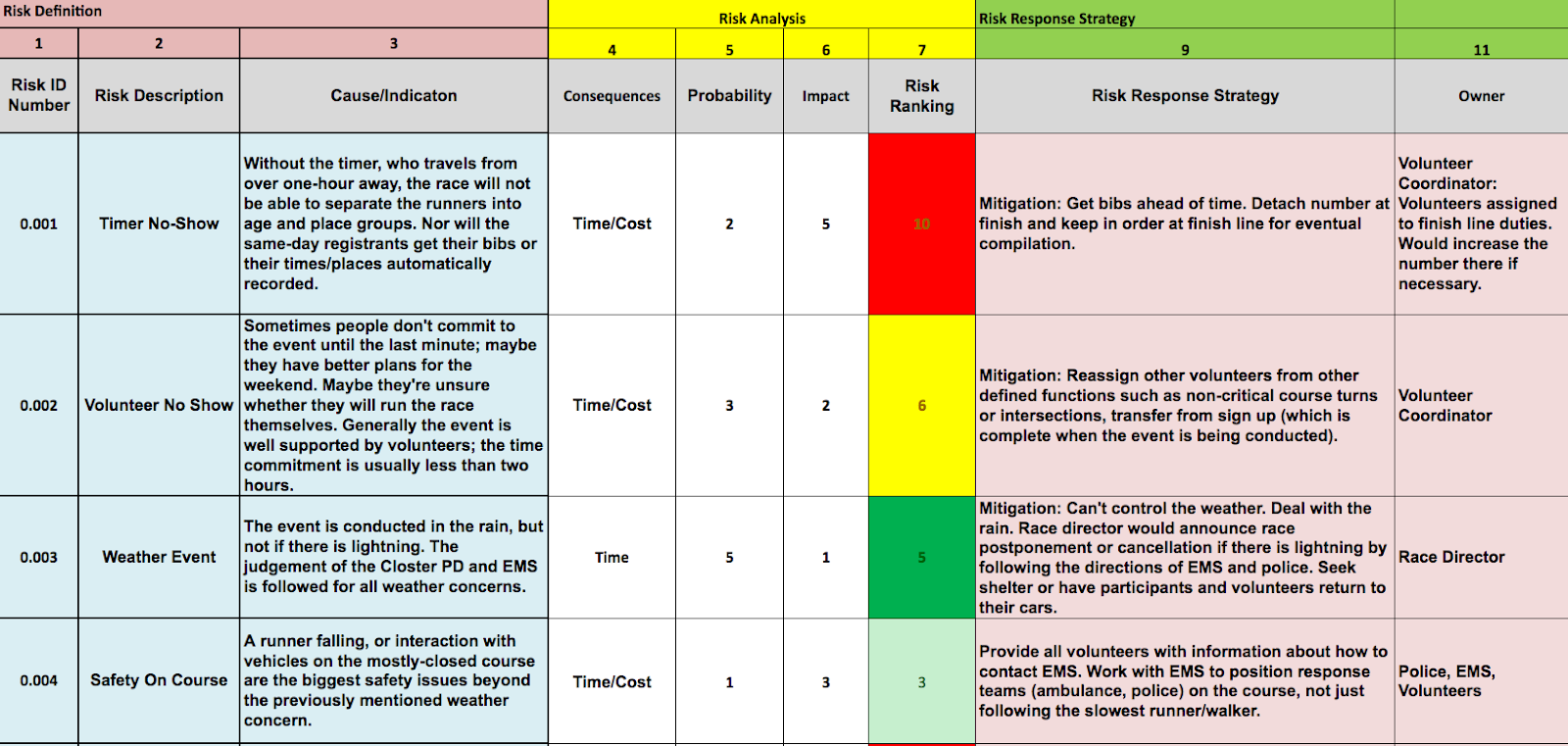
Risks, or rather the response to perceived, planned, and actual risks informs so many of the of the project attributes. With this in mind, it was important to “address risk management proactively and consistently throughout the project.” (PMBOK® Guide p. 311) The product is the Risk Register below.


(Click the image to open the Risk Register in a separate window as a Google Slide.)

While it would have been ideal to perform quantitative and qualitative risk analysis to develop the register, the fact of the matter is that the project is small and this isn’t an ideal world. For this project I’ll do what I can in the time allotted. I’ll connect as much as I can from the PMBOK® Guide to the Closter 5k. And this register is a pretty good start.

Thanks for visiting, reading, commenting, and connecting.


Stephen Miller’s LinkedIn Profile: https://www.linkedin.com/in/stephenlornemiller
Contact Email: Millerslm@gmail.com
Closter 5k Facebook: https://www.facebook.com/ClosterLaborDay5k/


Tuesday, February 21, 2017

Finding An Ethical Foundation in Project Management

Moving through my first reading of the Project Management Body of Knowledge (PMBOK), Fifth Edition, in preparation for my upcoming PM class, the patterns of Inputs, Tools & Techniques, and Outputs are recognizable and apparent.


This consensus-driven system for managing projects has been eye opening. Of course it’s understood that not all areas of knowledge will be applied to each project, and that it’s up to the judgement of the project manager and their experience to make the appropriate application of the various elements described in the PMBOK. But built into Project Management has also been a clear recognition of people doing the work and people expecting results. There is an underlying and explicit call for honesty and trust that is demanded of and by all people in all communication. In an example from the PMBOK's Project Quality Management chapter there's a recognition that "Meeting the customer requirements by overworking the project team may result in decreased profits and increased project risks, employee attrition, errors, or rework." (p228)


Ok. Maybe I’m idealizing some of this. Certainly there will be tough bosses, difficult interpersonal situations, tight timelines, and demanding project sponsors. That’s the working world.


Still, I was heartened to see on the Project Management Institute’s website, a system for managing not just projects, but a process for managing any ethical decisions surrounding projects. The process is termed the Ethical Decision Making Framework (EDMF). It is built upon the Project Management Institute Code of Ethics & Professional Conduct.


While I’m again maybe being a bit idealistic the PMI states that  “All PMI members, volunteers, certification holders and certification applicants must comply with the Code.” At the heart of the Code are  “honesty, responsibility, respect and fairness (emphasis by the PMI).


Just like the defined processes in the PMBOK, the EDMF “offers a structured step-by-step process to guide the critical thinking associated with addressing an ethical dilemma.” Yes, I’m sure that built into other certifications are a form of the Hippocratic Oath, to “do no harm,” or similar means of dealing with people honestly and fairly. I’m buoyed by the fact that these systems to built trust and resolve problems are built right into the Project Management systems that I’ve been reinforcing now going through the PMBOK a second time. The PMBOK is a checklist for doing good work and working well with others.

“Politeness and discretion in all communication” was a phrase that I used to repeat to my staff. But I could see modifying that phrase (which was created when I accidentally sent an email meant for a coworker to an external customer). It might be revised to something like: “Build and maintain trust through honest and fair communication.” It’s more than being polite, but about reinforcing trust with every word and letter and gesture. And it’s more than just being discreet. If you’re always acting honestly and fairly there won’t be anything to hide. Still, it’s probably advisable to triple check double check email before pressing the send button.


As always, your feedback is appreciated, so please share your thoughts about the 5KPM so far:


Stephen Miller’s LinkedIn Profile: https://www.linkedin.com/in/stephenlornemiller
Contact Email: Millerslm@gmail.com
Closter 5k Facebook: https://www.facebook.com/ClosterLaborDay5k/

Thursday, February 9, 2017

Develop Project Management Plan - Project Management For Road Racing

Just as the Closter 5k has a charter, the project will also have a Project Management Plan that “defines the basis of all project work.” (PMBOK® Guide p. 72) Because this plan will be “progressively elaborated by updates and controlled and approved through the Perform Integrated Control process,” (PMBOK® Guide p. 73), this process will be described here and an updated Project Management Plan will be periodically updated and eventually posted. This is one of the reasons I've been enjoying learning about Project Management. It's a puzzle that is making even more sense this second time through the PMBOK Guide. 


 4.2 Develop Project Management Plan
4.2.1 Develop Project Management Plan: Inputs
4.2.1.1 Project Charter
As earlier described and posted, there is a project charter for the Closter 5k as a part of the 5KPM project which showcases my work.
4.2.1.2 Outputs from Other Processes
As other plans are developed in PMBOK® Guide sections 5-13, and associated with the Closter 5k, the Project Management Plan will be revised, expanded, and updated.
4.2.1.3 Enterprise Environmental Factors
There are several environmental factors which will influence the Develop Project Management Plan Process. These factors generally include “industry standards” and the organizational structure.


Industry standards means conducting an event in the manner consistent with other similar 5k races. Participants know what to expect from the distance they run, the swag that they receive, and the results that are posted.


Regarding organizational structure, the Closter 5k is essentially a two-person operation for almost everything except the event-day execution of the race. An incredibly supportive sponsor has final oversight of the work, but the organizing committee, such as it is with two people, have free reign to use and incorporate different tools to make the project go. For example, we’ve moved away from emailing documents, to using shared on-line documents.
4.2.1.4 Organizational Process Assets
The shared on-line documents from prior years have become a trove of useful information that have been brought forward and updated for use in the present. We’ve always recorded historical information and lessons learned. This 5KPM project will form a standardized template and provide guidelines for future projects. How much a formal change control system will be in place is still uncertain, although one will no doubt be created for the practice of its creation and review.


4.2.2 Develop Project Management Plan: Tools & Techniques
4.2.2.1 Expert Judgment
The two main volunteers who conduct the Closter 5k have each volunteered at the event for seven years or more and know the tasks which need to be performed, the tools to get the tasks done, and what the required result should be. Our resources are limited, but we’ve tailored the processes, and our time commitments  to fit our schedules in order to serve the project. This isn’t to say that if we had more time and more resources the scope of the Closter 5k couldn’t be expanded. Indeed it would be great to have a kickoff meeting with a true facilitator of new and exciting ideas. While we add features to new events, they are incremental, not revolutionary.  
4.2.2.2 Facilitation Techniques
See above.


4.2.3 Develop Project Management Plan: Outputs
4.2.3.1 Project Management Plan
The Project Management Plan for the Closter 5k will be updated and periodically, in summary level or detail, with the baselines, subsidiary plans, and other descriptions, requirements, as these process areas are developed.


As always, your feedback is appreciated, so please share your thoughts about the 5KPM so far:

Stephen Miller’s LinkedIn Profile: https://www.linkedin.com/in/stephenlornemiller
Contact Email: Millerslm@gmail.com